

Creativity in Engineering
The software engineer as an artist

As a software engineer, do you feel able to express yourself through your code? Whether through the elegant simplicity of your solutions or the realisation of a visionary product idea? Does expressive creativity matter to you?
Bringing software into existence is as much an art as it is a science. Sure there are tools, techniques, and rigorous standards involved, but at the fundamental level, the work of the software engineer begins in the imagination - the creative tension of visualising what is possible in the virtual world and applying the skills, techniques, and aesthetic judgement honed from hours of deliberate practice and creative experimentation.
Software is appreciated for both form and function, for its beautiful elegance and its real-world applications. Great software is not just functional; it has an elegance, a simplicity, and a coherence that creates a satisfying UX. It is the product of both technical skill and artistic sensibility. Mastery in software engineering is navigating the interplay between logic and aesthetics.
Creative Tension
At its core, creativity emerges from the gap between what exists now and what could be. This gap, whether in software, music, or art, creates a tension that drives innovation. In software engineering, this might be the frustration of an inefficient process, the desperate need to simplify complex spaghetti code, or the vision of a seamless user experience. opportunities to design, refine, and build something better.
Brian J. Robertson, in his book “Holacracy”, describes this gap as tension - “the feeling of a specific gap between current reality and a sensed potential”.
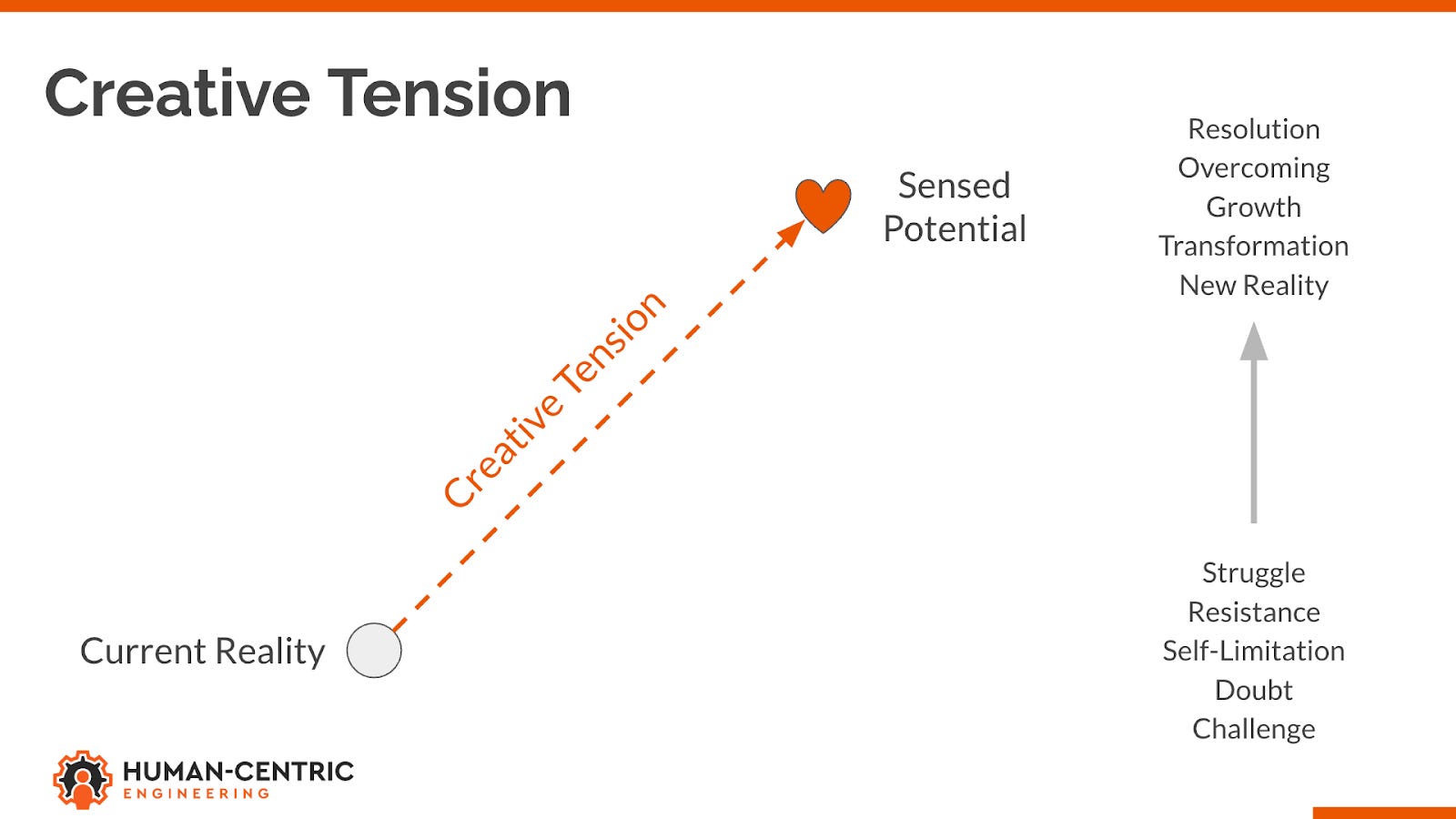
Composer and Management Consultant, Robert Fritz, expands on this idea in his book “Creating”, where he observes that just as tensions in music naturally seek resolution, so do tensions in life. He explains how tension is an essential part of the creative process:
"I call the relationship between the vision and current reality structural tension. During the creative process, you have an eye on where you want to go, and you also have an eye on where you currently are. There will always be structural tension in the beginning of the creative process, for there will always be a discrepancy between what you want and what you have. Why? Because creators bring into being creations that do not yet exist. Structural tension is a fundamental principle in the creative process. In fact, part of your job as a creator is to form this tension."
Robert Fritz
In software engineering, creative tension can arise everywhere:
The engineer who senses a way to make code more elegant but hasn’t yet found the right design pattern
The team that envisions a smoother user journey but struggles with technical debt and rigid backend constraints
The organisation that sees the potential for greater agility but is held back by legacy systems
Tension, whether in music, drama, or organisations, is a force that seeks resolution. It is a structural principle found in both nature and human-made systems. When we embrace tensions, lean into them instead of avoiding them, we unlock their creative potential. We can use tension to shape better products, teams, and ways of working.
The desire to resolve creative tension is found in the mind of the software engineer, just as it is found in the artist with a vivid imagination of what could be. The desire to create is fundamentally human.
How is creativity stifled in software engineering?
Let’s look at how opportunities for creativity and innovation can be impeded and squandered in our work as software engineers through the lens of the self, the team, and the organisation.
The Self
We are often our harshest critics, but this is self-defeating and limits our creative freedom.
I’m not the creative type
Perhaps we don’t see ourselves as the creative type. Our messy scribbles were criticised in art class at school, we’re tone-deaf, we cringe when recollecting our ballet lessons, and we can’t write for toffee. So, instead, we chose the path of reason and logic; the inputs and outputs of computers bring a satisfying, reliable predictability that the fuzzy world of arts and crafts lacks.
But this self-ascribed label of not being particularly creative is a fallacy when we consider the nature of ingenuity and experimentation involved in software engineering. By denying the creative aspects of our work, we close the doors to the joy of resolving complex challenges in novel ways, of designing elegant architectures, and of crafting intuitive user experiences. If we overly identify with the logical elements of building software, we may devalue the more experimental aspects of engineering and miss out on opportunities to let rip with our creativity.
I’m not sure I’m good enough
In his book, “The War of Art”, Stephen Pressfield explores the idea of resistance as an internal, insidious enemy that shows up as procrastination, self-doubt, fear, distraction, perfectionism, and rationalisation - all the excuse-making that prevents us from doing the work we are meant to do. We are challenged to overcome our struggles with resistance, face our underlying fears, realise that resistance is an inescapable part of creativity, and find systematic ways to “put your ass where your heart wants to be” and find the consistency and persistence that gets the creative work done.
I’m lacking inspiration
We can waste a lot of time seeking the right inspiration before starting, waiting for the right moment, but the best moment is always now. Inspiration often emerges spontaneously when we are actively engaged in something; whether erupting from our subconscious or floating out there in the ether awaiting our attention, it is experienced as a sudden spark of insight that triggers a compelling motivation to act. Our muse is attracted by our activity, as Picasso hinted:
“To know what you’re going to draw, you have to begin drawing” - Picasso
Inspiration follows engagement - it finds us when we simply start.
I can’t risk looking foolish
As software engineers, we quite rightly take pride in our expertise, but if we allow ourselves to become overly protective of our competency, our sense of status can take a battering when we follow the creative path. The trial and error of innovation requires humility, letting go of our pride to explore the unknown. The more expert we become and the more we identify with our expertise, the less we are willing to risk it all through experimentation.
“Start a huge, foolish project, like Noah. It makes absolutely no difference what people think of you.” - Rumi
Playfulness is for children
Should work always be a serious matter, or do we fall into the trap of performative seriousness? Many of us invest so much energy into “impression management”, playing the game of looking busy, appearing to be competent, always with an eye on career advancement, that we have completely lost that innate sense of playfulness we had as a child and frown upon others for naively indulging theirs.
In his book, Homo Ludens (Latin for “Playing Human”), the Dutch historian and cultural theorist Johan Huizinga proposes the idea that play is a fundamental and essential aspect of human culture and society, not just a leisure activity but a primary driver of civilisation itself. Playfulness is essential for creativity, and even though Google has now abandoned its 20% time, its legacy remains a testament to how structured play can lead to groundbreaking innovation, reinforcing Huizinga’s idea that play is not just leisure but a fundamental driver of progress.
Stuck in the detail
Sometimes, we get so used to being detail-oriented that we lose our versatility. We become enslaved by the detail, muddling through the day-to-day, losing sight not only of the bigger picture but also any sense of a dream we once had for ourselves, our creative vision of our potential. This is a far too common state of affairs.
In this situation, our challenge is to rediscover our potential, creating deliberate space away from the technical minutiae that can trap our engineer minds and remember to reconnect with our intrinsic motivations. Allowing ourselves to dream again, we can reignite the spark of potential that routine often dulls.
The Team
Engineering teams offer the potential for collective genius, but sometimes the dynamics work against us.
Not enough slack
Engineering teams that are overly indexed on delivery often lack the necessary slack for creativity and experimentation. There’s no breathing room for ideas, which can be suffocating for innovation. When every moment is accounted for and every team effort is jam-packed with tickets, there’s little opportunity to step back, question assumptions, or explore alternative approaches. Such a relentless focus on output can lead to stagnation as teams may become hyper-efficient at execution but struggle to evolve, adapt or solve problems in novel ways.
One approach to creating space for creativity is the Cool-down period within Basecamp’s Shape-up methodology, where after each six-week sprint, there is a two-week period with no scheduled work where people can breathe, meet as needed, and consider what to do next:
“During cool-down, programmers and designers on project teams are free to work on whatever they want. After working hard to ship their six-week projects, they enjoy having time that’s under their control. They use it to fix bugs, explore new ideas, or try out new technical possibilities.”
- Shape-up - Stop Running in Circles and Ship Work that Matters, Ryan Singer
Premature consensus-seeking
Teams are conscious of the benefits of being aligned with everyone pulling in the same direction, yet the premature consensus-seeking can stifle the exploration of alternative approaches. In our pursuit of efficiency, we may inadvertently suppress the creative flow of our colleagues, allowing the need for consensus to override innovative thinking. The instinct to maintain harmony can make challenging the status quo feel uncomfortable, discouraging fresh perspectives, and so there may be an unhealthy bias toward proven methods.
While team hackathons provide a burst of creative freedom, true innovation comes from building space for it into everyday work. Resisting the urge to optimise team capacity and utilisation creates a little slack for collective curiosity, experimentation, and discovery. Instead of pushing for agreement on solutions, we can provide the space to explore proposals with an open and creative mindset.
Rigid personalities
Teams can have power dynamics that get in the way of creative thinking. An overbearing senior may diminish the naive questioning of a more junior member whose differing perspectives could shine a fresh light on longstanding issues. In such conditions, engineers may find themselves self-sensoring, holding back on expressing their views due to a sense of poor psychological safety.
Certain team members can be stuck in their ways, projecting an air of unapproachable cynicism that snuffs out the fires in the bellies of more creative colleagues. Both misery and enthusiasm are contagious, and we must be on guard when pessimism prevents us from exploring the art of the possible.
Siloed knowledge
Whether intentional or not, hoarding knowledge can create a sterile environment where the green shoots of fresh ideas cannot take root. Instead of an open exchange of insights, information bottlenecks form, slowing progress and limiting opportunities for the cross-pollination of ideas.
Encouraging knowledge sharing, whether through pair programming, mentorship, documentation, lightning talks or open dialogue, creates a fertile ground for fresh perspectives.
The Organisation
Organisations are created by founders bursting with passion and creative energy, but as they scale, they tend to drift towards stifling bureaucracy and compliance, which can be destructive to the vitality of the creative force.
Engineers as task monkeys
Sadly, there’s a pervasive view in many organisations that sees engineers primarily as task-processing resources rather than creatives. The creative work happens in marketing or remains the purview of the product team. Despite trends towards an integration of product and engineering, where engineers are actively involved in product discovery and feasibility and have a close proximity to end users, there are many organisations where engineers feel like they are treated as ‘anoraks’ who nobody else in the organisation understands.
Just as the protagonist in the film “The Secret Life of Walter Mitty” was hidden away in the basement of the corporate office, so engineers are often tucked away, distanced from creative discussions, and shielded from meaningful customer interactions. Their role is often reduced to implementing requirements handed down from above, with little opportunity to contribute to the broader vision or creatively shape the product.
Bridging this void requires a shift in mindset, one where engineering is recognised not just as a function of execution but as an engine of innovation. Integrating engineers into the product development process, inviting them into discovery conversations, and encouraging creative problem-solving will lead to better products, more engaged teams, and a more fulfilling work culture.
Remote working
Remote teams can provide a challenge to creative happenstance. Those chance meetings that happen in person, where ideas and perspectives spontaneously collide to generate something new, are less likely to happen in remote and hybrid settings. In these situations, opportunities for synchronicity can be created more deliberately through intentional gatherings for divergent thinking, bringing cross-functional teams together to share perspectives and explore opportunities for collaboration.
Culture of judgement and evaluation
People are often on guard when coming together in organisations, especially in formal meetings. A cross-functional gathering of people with diverse perspectives could be a melting pot of ideas, but typically we’re on the defence because we feel the meeting as an exercise in judgement and evaluation.
“Most team meetings are implicitly framed as updating and decision-making encounters - a framing associated with judgment and evaluation. This frame makes people less willing to speak up and raise questions or concerns and offer novel ideas.” - Henrik Bresman and Amy Edmondson
To counter this, meetings could be explicitly framed as opportunities for perspective-sharing, spaces designed for the deliberate collision of ideas and the challenging of assumptions. By shifting the focus in this way, we create an environment where new ideas can breathe. One approach could be to set expectations at the start of each meeting, inviting open exploration rather than immediate evaluation. Simple prompts like “Let’s explore multiple possibilities - bold, unexpected, or even ‘wild’ ideas are welcome…” can set the scene for open and convivial sharing..
Risk aversion and institutional paralysis
Some organisations have to be risk averse, nobody wants their airline, hospital, or bank to be playing at the edges of risk. Others become risk-averse through habit, bureaucracy, or past failures that instilled a culture of caution. A single costly mistake or a high-profile incident can lead to layers of approvals, rigid processes, and an intolerance for experimentation - or worse, a blame culture. Over time, what starts as sensible diligence hardens into creeping bureaucracy where minimising risk takes precedence over pursuing opportunity. Decision-making processes or approval for new ideas become too slow and cumbersome to support rapid experimentation. The most innocuous code change then takes forever to make its way into production, and so engineers lose their experimental spirit and give in to the mediocrity that the system demands.
The worst-case scenario sees the eventual downfall of the organisation as the Innovator’s Dilemma plays out, where successful companies become resistant to change because they optimise for existing customers rather than innovating and adapting to emerging trends.
Short-termist productivity focus
Many organisations become trapped in short-term thinking, whether due to the relentless expectations of quarterly financial performance or the pressure of venture capital investors breathing down the necks of executives. In this environment, productivity metrics take centre stage, but instead of serving as useful indicators, they become the goal in themselves. Velocity, cycle time, and deployment frequency, meant to be signals of a healthy engineering culture, end up driving behaviours that prioritise short-term output over long-term impact. The focus shifts to shipping fast, meeting artificial deadlines, and squeezing more from every sprint, often at the expense of innovation and meaningful problem-solving. It can feel as if the treadmill is being run not for the organisation’s long-term success but merely to pacify external stakeholders. With resources stretched thin and efforts directed toward meeting the next metric, there’s no capacity for the kind of research and development that would drive longer-lasting prosperity.
Teams must remember to assert the value of outcomes over output and assert ownership over their own productivity metrics as tools for feedback and enablement - not for setting arbitrary targets. By shifting the focus back to meaningful results, such as customer satisfaction, business impact, and market differentiation, teams may find the freedom to work in ways that align their efforts with genuine progress rather than superficial efficiency.
Are engineers really artists?
While the parallels between art and engineering are obvious to some, there will likely be engineers who don’t see it that way. If you've ever wandered through a modern art exhibition, where a splattered canvas to a childlike doodle is hailed as artistic expression, a degree of skepticism is understandable. Sloppy code as an expression of personal style is not going to win you many friends in engineering.
Art exists largely for self-expression, emotion, and aesthetics. In art, there is an emphasis on beauty over function, whereas in engineering, we focus primarily on function while often neglecting beauty and elegance - unless you’re engineering video games, of course. Nonetheless, at its core, software engineering is still an act of creation - turning an idea into something real, something people interact with, often shaping their experience in subtle, even emotional, ways.
Just as artists work within constraints such as medium, technique, and composition, so too do engineers. But where artists may push boundaries freely, engineers must navigate technical limitations, user needs, and business goals, creatively balancing these forces to solve problems within structured, often rigid, frameworks. Creativity in engineering isn’t about artistic flourishes, it’s about making smart, innovative choices within constraints to build something that is both functional and beautiful.
Regaining the creative spark
Driven by problem-solving curiosity, software engineers are great at pointing to gaps between current reality and a sensed potential. Instead of lamenting these gaps, they can be seen as creative opportunities beyond designing software, extending to optimising processes, structuring teams, and unblocking constraints that hinder flow.
As engineers, we’re not just building the software; we’re shaping the systems and cultures we operate in. We create tools and techniques, and those tools and techniques recursively shape us - a process of continual creativity.
No matter the degree we see ourselves as artists, the work of software engineering is a deeply creative pursuit.
Brilliant! So much rings true on the stifling nature of product-led everything in many organisations, engineers as task-monkeys is often the view as you say and leaves creative engineers bored and under-valued, great article 👍